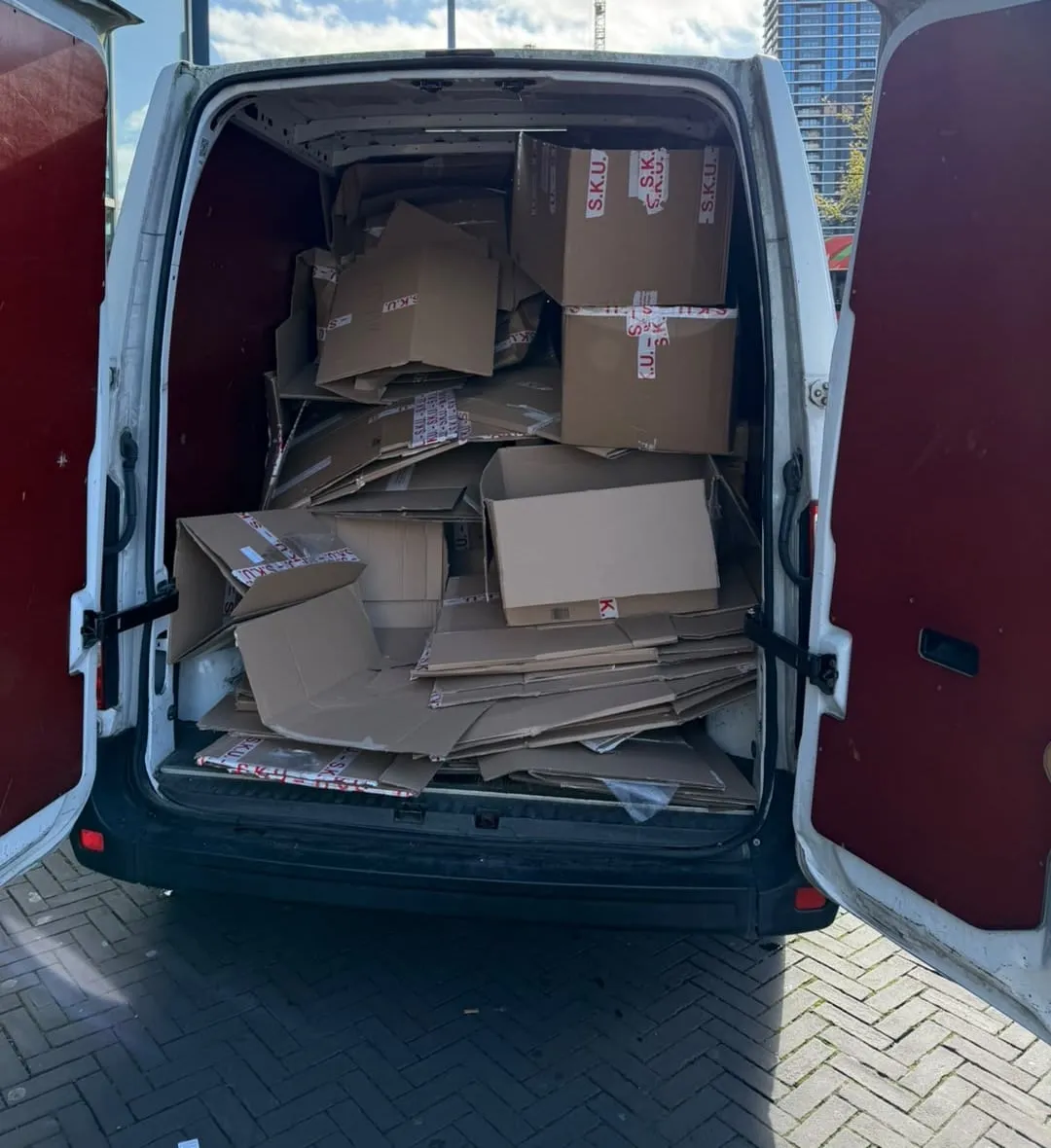
You request a pickup in 1 minute and mention that you'd like a regular schedule. Together we choose weekly, fortnightly or monthly, plus a set day and time slot. You get a fixed price per pickup up front. Busy week? We scale up. Quiet week? You skip it. No long contract is needed.
01What exactly is a regular cardboard collection?
A regular cardboard collection means we come round on an agreed rhythm, day and time slot to take away all the cardboard you have gathered. You don't have to book, ask for a price or find a time slot every single time.
With a one-off request, you arrange everything each time: fill in the form, send a photo, receive a price, agree a day. That works fine if you have the odd pile of boxes now and then. But if cardboard comes in every week, arranging its removal becomes a recurring chore in itself. A fixed arrangement takes that chore off your plate.
You agree once how often we come, on which day and in which time slot. After that, it's in the schedule. We take away the cardboard that builds up between two pickups and bring it to an approved paper and cardboard recycling facility. We do the carrying ourselves, including from an upper floor or a basement storeroom.
Weekly cardboard collection is mostly about rhythm. It isn't one big job, but a fixed habit that keeps your space clear. If you'd first like to know how a single pickup works, read our general page on cardboard collection in Amsterdam.
02Weekly, fortnightly or monthly: which rhythm suits you?
The right rhythm depends on how much cardboard comes in and how much storage space you have. If you have little space and lots of deliveries, choose weekly; if you have a roomy storeroom and a steady trickle, fortnightly or monthly often works out better.
The real question is this: how long can you keep cardboard before it gets in the way? In a small business unit, or a shop with a storeroom of a few square metres, that's often no more than a week. In an office with a large basement, a month is perfectly fine.
Look at when the cardboard arrives, too. If your stock comes in every Monday, there's little point in a Monday morning pickup. A collection at the end of the week, once everything has been unpacked, gets more done. The rhythm and the day go hand in hand.
If you're not sure, start with fortnightly. After a few pickups you'll see whether the stack gets too high or stays small. Then we move the rhythm up or down. That can always be changed by arrangement.
| Rhythm | Suits | Storage space you need | Keep in mind |
|---|---|---|---|
| Weekly | Webshops, shops, restaurants and cafés, businesses with several deliveries a week | Little: one week of cardboard | Pick a day after your busiest delivery day |
| Fortnightly | Offices, practices, small webshops, homeowners' associations (VvE) with a shared storeroom | Medium: two weeks of cardboard, flattened | Keep the cardboard dry between pickups |
| Monthly | Businesses with a quiet flow, households with a steady stream of online shopping boxes | Plenty: a month of cardboard, flattened and stacked | Keep escape routes and corridors clear |
03How do you estimate how much cardboard you have each week?
For one ordinary week, count every empty box you flatten and see how high the stack gets. That one measurement tells you more than any estimate in advance.
Most people underestimate their cardboard, because the boxes are scattered around the building. A few by the packing table, a few in the kitchen, a few under a desk. Only when you gather everything in one place do you see what really comes in each week.
So here's how to do it: choose a fixed collection point, flatten every empty box straight away and add it to the stack. At the end of the week, take a photo. Send that photo on WhatsApp to 085 115 0200, and we'll help you work out which rhythm makes sense. The bonus is that you now have a fixed collection point for the rest of the arrangement.
Include your old paper in the estimate, too. Flyers, printed order slips and old catalogues can go in the same pickup. Read more on our page about paper recycling pickup.
| What you see after a week | What it means | Sensible rhythm |
|---|---|---|
| A small pile of flat boxes that fits in a cupboard | Not much cardboard, it isn't in the way | Monthly, or book a one-off pickup when it fills up |
| A stack up to roughly knee height | Noticeable, but you can still store it | Fortnightly |
| A stack up to hip height or higher | Cardboard is starting to eat into space and walkways | Weekly |
| Several stacks, or unfolded boxes in every corner | You have more cardboard than storage | Weekly, with extra pickups in busy periods |
04How does a fixed collection day with a time slot work?
We agree a set day and time slot with you, for example Thursday morning. You choose that slot so the pickup doesn't disrupt your work or your day.
We don't promise fixed route days per district. We agree the day and time slot with you, based on what works for you and what fits our schedule. That way your rhythm isn't dictated by a timetable that doesn't suit your business or household.
When choosing the time slot, think about three things. When is the week's cardboard unpacked? When is it quiet in your building? And will someone be there to open the door, or can we get into a storeroom or back entrance? Mention it in your request and we'll take it into account.
In the city centre, access matters even more. Loading bays are scarce, and heavier vehicles face delivery time windows and low-emission zone rules. A fixed morning slot often works best there. Read more on our page about cardboard collection in Amsterdam city centre.
A typical scenario: a small webshop in a shared business building in Oost gets stock deliveries on Tuesday and Wednesday. The regular pickup is on Friday morning, so the packing room goes into the weekend empty and starts Monday with a clean slate.
05What do you do in busy weeks, such as the holidays or a sale?
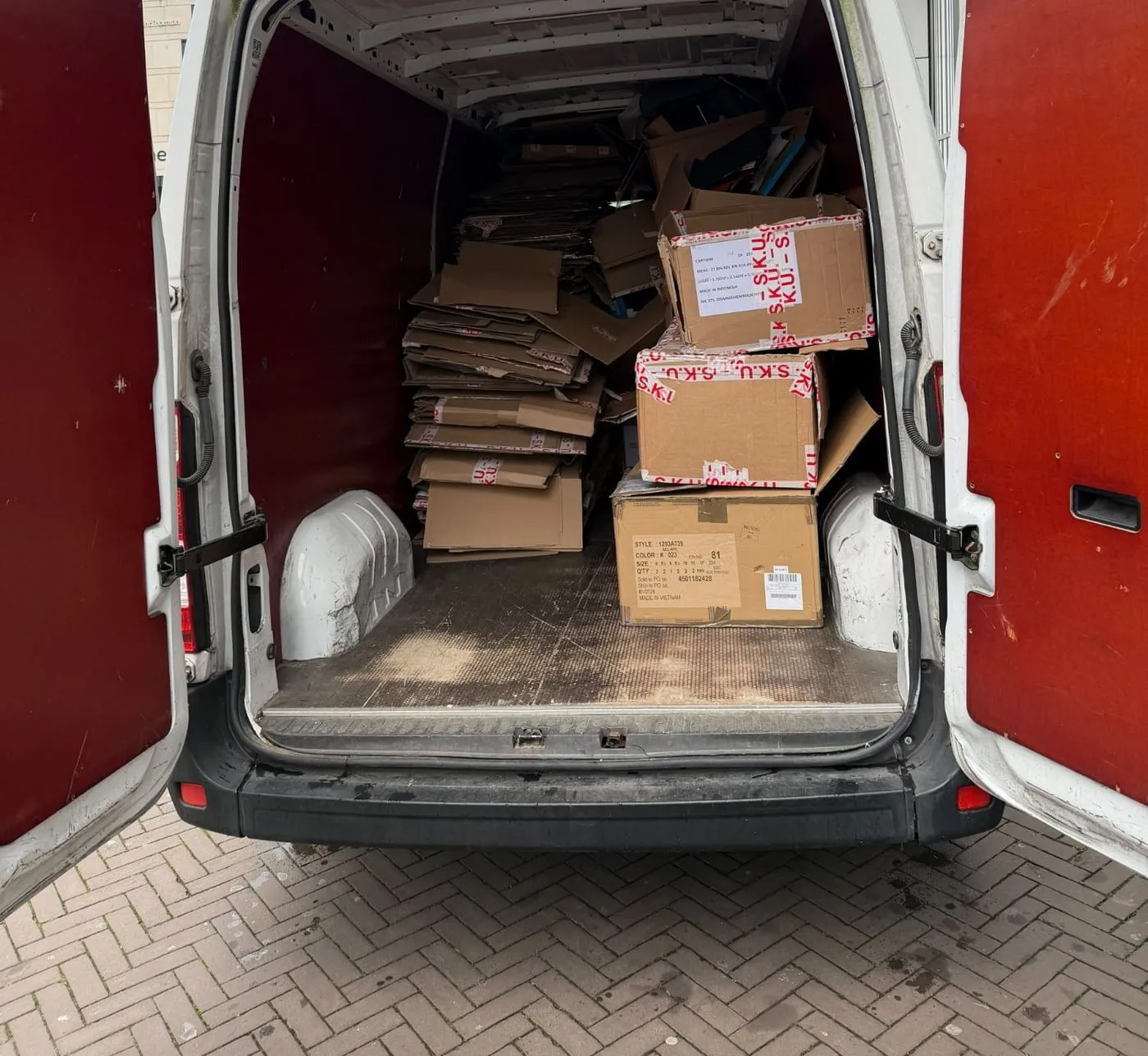
You let us know in advance, and we scale up with an extra pickup or more room in the van. A fixed rhythm is a baseline, not a ceiling.
Almost every business has peaks. A webshop sees the flow surge around Black Friday, Sinterklaas and Christmas. A shop suddenly gets far more stock just before a new season or a sale. An office gets new hardware for the whole team in a single week. In weeks like that, your normal rhythm is too tight.
Send us a message on WhatsApp a few days beforehand, or email info@meubelophalers.nl. Tell us what you expect, for example double the usual amount or an extra slot midweek. You then get a fixed price for that extra pickup up front. After the peak, your arrangement simply drops back to its normal rhythm.
A typical scenario: a concept store in West normally has its cardboard collected fortnightly. In December the arrangement temporarily moves to weekly, because the holiday stock arrives in large outer boxes. In January the rhythm goes back to fortnightly. You'll find specific tips for retailers on our page about cardboard collection for shops and restaurants.
- The holidays and the whole of December
- Black Friday and other promotions
- Seasonal changeovers and sales
- A new fit-out or a large delivery
- A stocktake or a big clear-out
06Can you skip a pickup in a quiet week?
Yes. If there's little cardboard one week, or your business is closed, let us know in advance and we'll skip that pickup.
A fixed arrangement doesn't oblige you to have half a stack collected every time. During the summer holidays, while you're closed for a refurbishment, or simply in a quiet month, there is sometimes too little cardboard to make a pickup worthwhile. Then we move on to the next slot.
Do let us know in good time, ideally a few working days beforehand. That way we can adjust the schedule and won't find ourselves standing at a locked door. A short WhatsApp message is all it takes.
If you notice that you skip more often than you have cardboard collected, your rhythm is probably too frequent. We'll then look together at whether fortnightly or monthly suits you better. The same works the other way round: if you keep booking extra pickups, a more frequent fixed rhythm is often easier. That way the arrangement stays flexible and can be adjusted by agreement.
07Do you need your own container or wheelie bin?
No. With a regular cardboard collection you don't need to hire a container or wheelie bin, or arrange a spot for one. We take the cardboard from wherever it's stored.
A container might seem logical with a fixed rhythm, but in Amsterdam it often gets in the way. There isn't room on every pavement, it takes up space in a courtyard or corridor, and it sits half empty most of the time. On top of that, you still have to carry the cardboard to the container yourself and cram it in.
With Kartonophalers, you gather the cardboard in a spot you choose: a storeroom, a corner of the business unit, a basement or a hallway. We come inside, carry it to the van and take it away. Nothing is left behind on the street. Our page on the cardboard skip alternative explains the differences in more detail.
For the best way to store cardboard between two pickups, see our knowledge base article on how to prepare cardboard for pickup. In short: flat, stacked, dry and never in front of a fire exit.
08How do contact and invoicing work with a regular collection?
You have one point of contact for planning, changes and questions. You receive an invoice per period, in your company name if you wish.
With a fixed arrangement, you don't want to explain your situation from scratch every time. That's why everything runs through one point of contact. Want to move a pickup, add an extra one or skip one? Send a message to 085 115 0200 or an email to info@meubelophalers.nl. We'll already know where you are, what your building looks like and where the cardboard is kept.
The price is fixed up front and based on the amount and the situation: the floor, whether there is a lift and how far the van is from the door. There are no surprises afterwards. A regular cardboard collection is a paid service. It isn't a free collection, and we don't buy cardboard.
For invoicing, we agree a period that suits your accounts, for example monthly. The invoice lists the pickups from that period. If you use a purchase order number, cost centre or separate billing address, let us know at the start. Businesses that mainly want to know whether commercial waste can go in household containers will find the answer on our page about business cardboard collection.
| Topic | What we'd like to know | Why |
|---|---|---|
| Rhythm | Weekly, fortnightly or monthly | The basis for our planning |
| Day and time slot | Which day and which part of the day suits you best | The pickup fits into your week |
| Collection point | Storeroom, basement, unit, hallway, floor, lift | Determines the walking route and the price |
| Access | Who opens up, key or door code, back entrance | Avoids a locked door |
| Billing details | Company name, billing address, purchase order number if needed | Your periodic invoice is right first time |
09Is a regular collection also an option for households or a homeowners' association?
Yes. Households with a steady stream of online shopping boxes and homeowners' associations (VvE) with a shared storeroom can also agree a fixed rhythm. It works exactly the same as for businesses.
If you order a lot online, you'll know the problem. Parcels arrive every week and the underground paper container nearby is often already full. Cardboard has to go in flat and small, and a large box simply won't fit through the slot. A monthly pickup keeps your hallway or storeroom clear, without you having to walk to the container with boxes every time.
For a homeowners' association, known in Dutch as a Vereniging van Eigenaars or VvE, things are slightly different. In a shared bike store or basement storage area, residents sometimes pile up boxes that nobody takes away. It looks messy, takes up space meant for bikes and can block an escape route. A regular pickup from an agreed spot in the storeroom prevents that. The VvE makes the arrangement, we do the collecting.
A typical scenario: a VvE in an apartment complex in Nieuw-West agrees a monthly pickup. Residents leave their flattened boxes in a marked spot in the storeroom. On the agreed collection day we take everything away, and the invoice goes to the VvE per period.
If a house move suddenly leaves you with lots of boxes, a one-off pickup is more practical than a fixed rhythm. See our page on moving boxes pickup. If it's large furniture boxes after a new interior, read about furniture packaging removal.
10How do you start a cardboard collection subscription in Amsterdam?
You request a first pickup in 1 minute and mention that you'd like a fixed rhythm. After that first pickup, we agree the rhythm, day, time slot and invoicing together.
We sometimes call it a subscription, but there's no long minimum term attached. It's an arrangement made by agreement that you can adjust as you go. That way you can find out at your own pace which rhythm works, without being tied to something that no longer fits after a few months.
The first pickup doubles as a useful measurement. We see how much cardboard there is, what the walking route looks like and where the van can park. Based on that, you get a fixed price per pickup that matches the agreed rhythm. We come round for that first collection within 1 to 2 working days of your request.
- Request: request your pickup in 1 minute with what, how much, the address and your preferred day. Mention in the notes that you'd like a regular collection.
- Send a photo: send a photo of your weekly stack on WhatsApp for a quick estimate.
- First pickup: within 1 to 2 working days we carry everything out and take it for recycling.
- Set the rhythm: together we agree the rhythm, fixed day, time slot and invoicing period.
- Adjust as needed: scaling up, skipping or changing the rhythm takes just a message.
11Where in Amsterdam can you get weekly cardboard collection?
In every district of Amsterdam and the towns right around the city. We agree the rhythm and the day per address.
We collect in Centrum, Zuid, West, Oost, Noord, Nieuw-West and Zuidoost. We also drive to Amstelveen, Diemen, Badhoevedorp, Zaandam, Hoofddorp, Ouderkerk aan de Amstel and Duivendrecht. If you have several addresses, such as a shop and a storage unit, we can combine them by arrangement.
The team behind Kartonophalers is the same team behind Meubelophalers, the company we are part of, with 1,650+ happy customers in Amsterdam. You can read more about who will be turning up on our about us page. Want to see every option for getting rid of cardboard side by side first? Take a look at where to dispose of cardboard in Amsterdam.
Curious what happens to your cardboard after the pickup? Read what happens to collected cardboard. Ready to go? Request your pickup in 1 minute and tell us which rhythm you have in mind.