Residents put small amounts of flattened cardboard in the paper recycling bin and never leave cardboard next to a full bin, because the municipality can enforce this and issue fines. Businesses are not allowed to use household bins for their cardboard and must have it collected. Cardboard does not belong on the pavement or in an escape route. Always check the current rules with the City of Amsterdam.
01Which rules apply to disposing of cardboard in Amsterdam?
The core idea is simple: cardboard belongs in the right collection, not on the street. Residents and businesses have different obligations.
Anyone looking up the cardboard disposal rules in Amsterdam usually wants to know one thing: am I allowed to do what I am planning? The rules come down to three questions. Who are you, a resident or a business? Where are you putting the cardboard: in a bin, out with bulky waste or inside your own building? And how much cardboard are we talking about?
Below are the most important rules at a glance. We deliberately keep them general, because the municipality adjusts its rules, collection times and enforcement from time to time. Check the current rules with the City of Amsterdam before doing anything you are unsure about.
Mainly looking for practical routes, such as the paper bin, the Afvalpunt or giving boxes away? We compare those on the page where to get rid of cardboard in Amsterdam. This page is about what is and is not allowed.
| Rule | Who it applies to | What it means in practice |
|---|---|---|
| No cardboard next to the bin | Everyone | If the bin is full, you take the cardboard back with you or choose another route. The municipality can enforce this and issue fines. |
| No commercial waste in household bins | Businesses and self-employed people | Cardboard from your business is collected by a waste collector. |
| Bulky waste only according to the collection rules | Residents | Only at the right time or by appointment, not on any random day. |
| No cardboard left on the pavement or in the entrance | Everyone | Loose cardboard on the street counts as waste in the wrong place and causes a nuisance. |
| Keep escape routes clear | Residents, owners' associations (VvE), tenants | No piles of boxes in the stairwell, walkway or hallway. |
| Skip on the street only with permission | Everyone | You need permission in advance for a skip or container on the public road. |
02Are you allowed to leave cardboard next to a full bin?
No, leaving cardboard next to a full paper bin is not allowed. The municipality can enforce this and issue fines, even if you have stacked it neatly.
It feels logical: the bin is full, you have already carried the cardboard downstairs, so you just leave it next to it. Even so, that counts as waste put out incorrectly. Cardboard next to the bin blows away, gets wet, attracts other rubbish and makes the street look messy. That is why the rule is strict.
When people think of a fine for cardboard next to a bin, many assume it only applies to bags of household rubbish. That is not the case. A tidy stack of boxes or a flattened moving box next to the bin can also lead to enforcement. We deliberately say nothing about amounts or the exact procedure: check the current rules with the City of Amsterdam.
So what should you do instead? Take the cardboard back inside and try again later, or choose a route that suits the amount. For a big pile, the paper bin is not the right place anyway, even when it is empty.
What if your cardboard is already outside?
Bring it back in as soon as possible, ideally before it rains. Wet cardboard turns heavy and limp and is harder to recycle. If you want to get rid of it all in one go, you can book your pickup in 1 minute and keep it dry indoors until then.
03Which rules apply to residents and which to businesses?
Residents may put household cardboard in the neighbourhood paper bin. Businesses may not, and must have their cardboard collected.
The difference is not in the type of cardboard but in where it comes from. A box from an online order at home is household waste. The same box from a shop's stockroom is commercial waste. As a business owner you pay for collecting the latter yourself, because the municipal bins are meant for households.
Not sure whether something counts as commercial waste, for example if you work from home or run a small webshop from your flat? Then put the question to the City of Amsterdam. We do not give legal advice on that, but we do collect cardboard for both households and businesses.
| Topic | Resident | Business |
|---|---|---|
| Neighbourhood paper bin | Yes, for small amounts of flattened cardboard | No, not meant for commercial waste |
| Municipal Afvalpunt recycling centre | Yes, if you bring it and arrange transport yourself | Not for commercial waste, check the current rules with the municipality |
| Bulky waste (grofvuil) | According to your neighbourhood's collection rules | Not for commercial waste |
| Arranging a collection | Always allowed, handy for large amounts | Required: have your cardboard collected |
| Cardboard next to the bin | Not allowed | Not allowed |
04What are the rules for commercial cardboard waste?
Cardboard from a business is commercial waste and does not belong in household bins. You have it collected, as a one-off or on a recurring basis.
The key rule for commercial cardboard is that as a business owner you are responsible for your own waste. That applies to an office, a shop, a restaurant, a practice or a storage unit. Slipping a few boxes into the neighbourhood bin may seem minor, but the municipality can take action on it.
For most businesses a fixed arrangement works best. For example, we collect weekly, fortnightly or monthly, by agreement and easy to adjust. Read more about that approach on the page about business cardboard collection in Amsterdam. For businesses with lots of deliveries, such as cafés and shops, there is a separate explanation under cardboard collection for shops and restaurants.
A typical situation: a small business in Oost receives boxes twice a week and has no bin of its own. Cardboard piles up in the back room and the temptation to use the neighbourhood bin is strong. With a regular pickup that problem disappears and the back room stays usable.
- Keep cardboard indoors or on your own premises until the pickup.
- Never put business cardboard in or next to a household bin.
- Keep emergency exits and corridors in your building free of boxes.
- Check the current rules for commercial waste with the City of Amsterdam.
05What are the rules for putting out bulky waste?
You only put bulky waste (grofvuil) outside at the time the municipality sets for your neighbourhood, or by appointment. Outside those times it counts as waste in the wrong place.
In Amsterdam, bulky waste works differently per neighbourhood: by appointment or on fixed days. Exactly what applies and from what time you may put things out varies and changes. That is why we do not list days or times here. Check the current rules with the City of Amsterdam for your address.
Bulky waste is meant for large items such as furniture and mattresses. Whether cardboard is allowed and in what form is explained in detail in our knowledge base article can cardboard go out with bulky waste in Amsterdam. For this page one rule is enough: if you put bulky waste out at the wrong time, you risk enforcement by the municipality.
06Can cardboard be left on the pavement or in the entrance?
No, you do not leave cardboard on the pavement, in the building entrance or by the front door. Not even overnight while you wait for a pickup.
On the street, loose cardboard quickly counts as waste put out incorrectly. It also blocks the pavement for pedestrians, wheelchairs and pushchairs. In the narrow streets of the city centre there is barely any room to begin with. A stack of boxes in front of a canal house is in everyone's way straight away.
Waiting for a pickup? Then keep the cardboard indoors until it is collected. With us you agree on a spot, such as a storage room, a courtyard or the hallway of your own home. Read more about how we work in narrow streets on cardboard collection in Amsterdam city centre.
07Can you store cardboard in the stairwell or a shared space?
Best not to: cardboard is flammable and a stairwell is an escape route. Owners' associations (VvE) often have their own house rules about this, and escape routes must always stay clear.
A stairwell, walkway or shared corridor is the way out in a fire. Boxes in that space catch fire easily and can block the exit. That is even more true in older buildings with narrow, steep stairs, where a few boxes can take up half the staircase.
Many owners' associations set out in their house rules that nothing may be left in shared areas. If you live in a block or complex, check those house rules or ask the VvE board. If you rent, your landlord may have rules too. We are not inventing rules here, but the starting point is always the same: keep escape routes clear.
A typical situation: after a move in Nieuw-West, forty boxes end up on the shared walkway because they are in the way inside. The neighbours cannot get past and the VvE sends a message. It is better to flatten the boxes indoors and book a pickup straight away, for example through our page on moving boxes pickup.
| Location | Suitable? | Point to watch |
|---|---|---|
| Your own home or private storage room | Yes | Dry and away from heat sources |
| Stairwell or building entrance | No | Escape route, must stay clear |
| Shared walkway or corridor | No | Escape route and often banned under VvE rules |
| Shared bike storage | Only if the VvE allows it | Not in front of doors or passageways |
| Pavement or in front of the door | No | Rubbish on the street, risk of enforcement |
| Balcony | Limited | Rain makes cardboard wet and heavy |
08Do you need permission for a skip on the street?
Yes, you need permission from the municipality in advance for a skip or waste container on the public road. Without that permission the municipality can take enforcement action.
During a renovation or a big move, people quickly think of a skip outside the door. You cannot simply put one on the public road. You need permission and the spot has to work, which can be tricky in the city centre with little loading space and narrow streets. Check with the City of Amsterdam which permit or notification you need.
For cardboard alone, a skip is often more trouble than it is worth. You arrange permission, pay for the space and the skip stands outside your door for days. We explain the differences on the page an alternative to a cardboard skip. For a renovation that also produces building waste, a skip does make sense, because we do not take that.
09What do we take when you book a cardboard pickup?
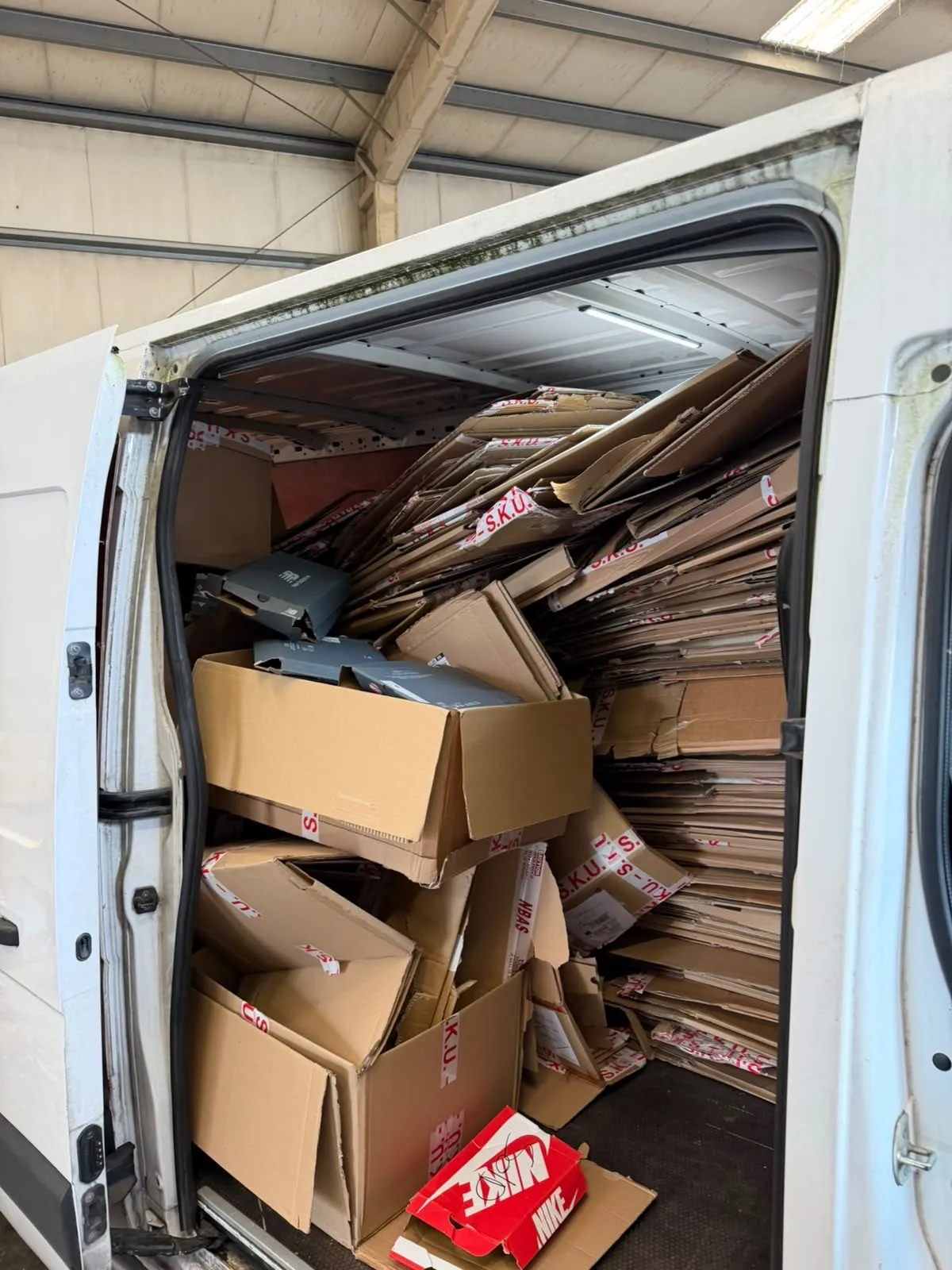
We take every kind of cardboard and paper, from moving boxes to cardboard tubes. Everything goes to certified paper and cardboard recycling.
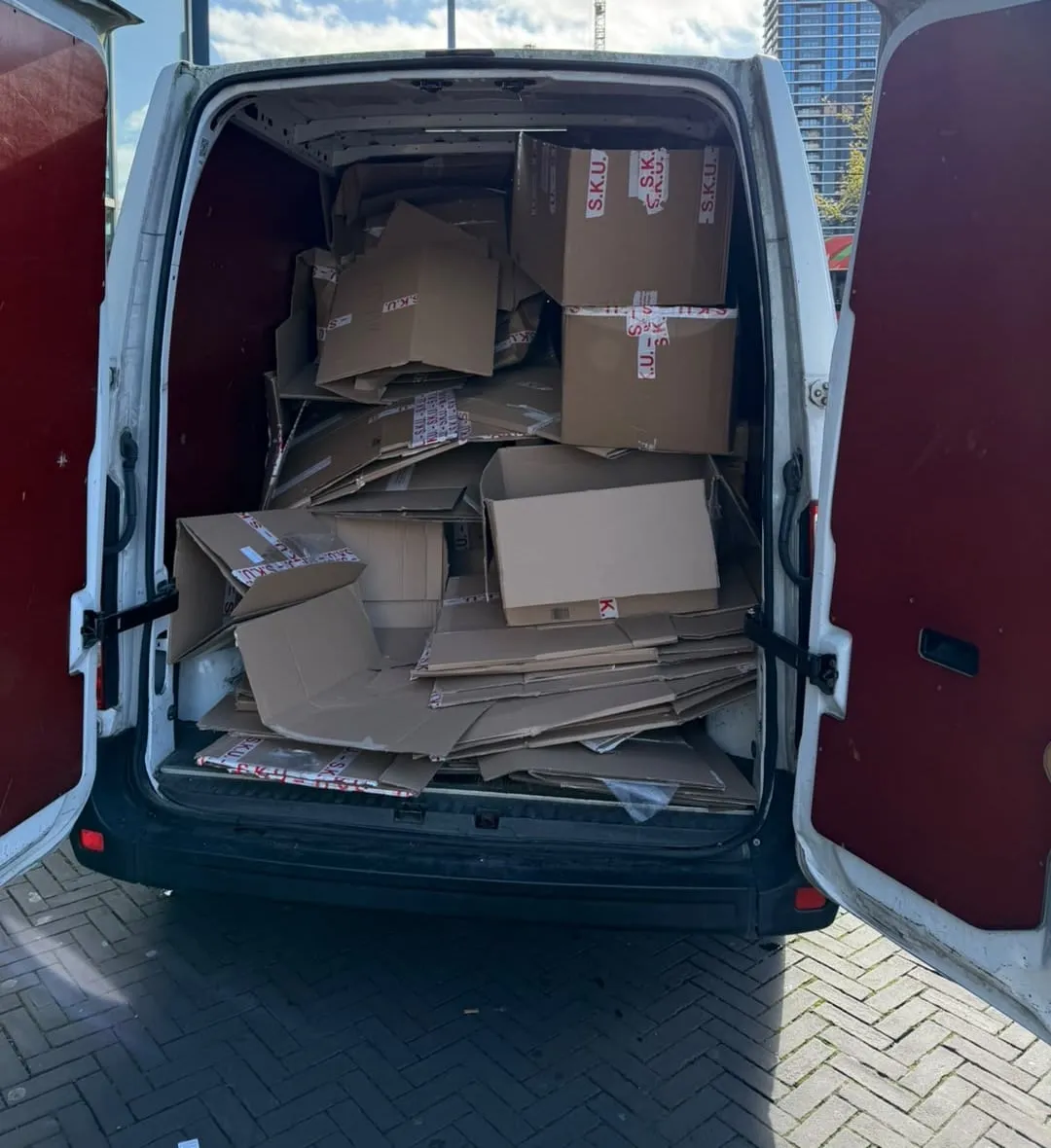
Now for part B: our own collection rules. They are there so you know where you stand beforehand and the price we agree up front is accurate. You book a pickup with what you have, how much, your address and a preferred day. Within 1 to 2 working days we come by and carry everything out ourselves, including from upper floors.
You get a fixed price up front based on the volume and the situation, such as the floor, the lift and the distance to the van. It is a paid service: we do not buy cardboard and it is not a free collection. Want to know what happens to the cardboard afterwards? Read what happens to collected cardboard.
| Type | Examples | Tip |
|---|---|---|
| Cardboard | Boxes from orders, product boxes, cardboard sheets | Flattening saves space |
| Corrugated cardboard | Heavy shipping boxes, furniture boxes, appliance boxes | Large sheets can stay whole |
| Moving boxes | Used moving boxes, including ones with writing or tape on them | Hand them over empty and dry |
| Paper | Leaflets, newspapers, magazines, ordinary office paper | Bundle it in a box or bag |
| Shoeboxes | Loose shoeboxes, also in large numbers | Collect them in bigger boxes |
| Cardboard corner pieces and tubes | Corner protectors, poster tubes, fabric roll cores | Keep them together in a box |
10What should you mention in advance, and what can we not take?
Mention plastic film, polystyrene, bubble wrap and wood or pallets in advance, so we know what we are taking and the price is right. We do not take construction and demolition waste, hazardous waste, food waste or confidential archives that need shredding.
With a delivery or a move, cardboard rarely comes on its own. It is wrapped in film, packed with polystyrene and sometimes sits on a pallet. Mention this when you book or send a photo on WhatsApp to 085 115 0200 (+31 85 115 0200 from a foreign number). We will then check in advance what can go and how it fits into the price. Read more about mixed packaging on packaging waste collection.
Some waste streams are not for us. Construction and demolition waste, hazardous waste and food waste need different processing. Confidential archives that must be verifiably destroyed, such as files containing personal data, should go to a company that specialises in secure document destruction. Ordinary old paper without sensitive information we are happy to take, see paper recycling pickup.
| Category | Examples | What we do |
|---|---|---|
| Mention in advance | Plastic film, stretch wrap, bubble wrap | Tell us how much and we agree in advance what can go |
| Mention in advance | Polystyrene and foam inserts from packaging | Let us know, as it takes up a lot of space in the van |
| Mention in advance | Wood, wooden crates, pallets | Tell us the number and size and we will see if it can go |
| Cannot be taken | Construction and demolition waste, rubble, plasterboard, insulation | Arrange suitable removal for this |
| Cannot be taken | Hazardous waste such as paint, chemicals, batteries | Take this to the right collection point, check with the City of Amsterdam |
| Cannot be taken | Food waste and cardboard full of food scraps | Remove the scraps or put it in general waste |
| Cannot be taken | Confidential archives for destruction | Have a specialist document destruction company handle this |
11What do we do with wet or greasy cardboard?
Dry cardboard is the standard. Wet cardboard is heavy and harder to recycle, and greasy cardboard with food scraps does not belong in the paper stream.
Cardboard that has stood in the rain overnight weighs many times more and tears when you lift it. Soaked cardboard is also harder to recycle. Slightly damp cardboard is usually not a problem, but let us know if part of it is really wet. That way we know what to expect and the arrangement stays accurate.
Greasy cardboard, such as pizza boxes with grease stains or packaging with food scraps, disrupts paper recycling. You can tear off the clean parts, and the rest goes in general waste. For restaurants and cafés with a lot of this kind of packaging, we agree in advance what can and cannot go in the cardboard stream.
| Condition | Can it go? | What you can do |
|---|---|---|
| Dry and clean | Yes | Fold it flat and have it ready |
| Slightly damp | Usually yes | Let it dry indoors and mention it when you book |
| Soaked | By arrangement | Let us know in advance with a photo |
| Grease stains, no food scraps | By arrangement | Tear off the clean parts, greasy parts go in general waste |
| With food scraps | No | Remove the scraps or put it in general waste |
12How accessible does the cardboard need to be, and do you need to be home?
The cardboard must be in an agreed, accessible spot and must not block an escape route. If it is ready there, you do not need to be home.
When you book, tell us where the cardboard is: in your home, in a storage room, at the back of the shop or in a courtyard. Also mention the floor, whether there is a lift and roughly how far the van will be from the door. That determines the fixed price you get up front.
Will you be out? No problem, as long as we can get to the cardboard. Think of an unlocked storage room, a key with the neighbours or an agreed spot inside the building. Do not put it on the pavement or in the stairwell, for the reasons above. For tips on getting it ready, see how to prepare cardboard for pickup.
| Check | Why |
|---|---|
| The agreed spot is accessible | We need to reach it, even if you are not home |
| Access arranged (key, door code, neighbours) | Avoids a wasted trip |
| Floor and lift details passed on | Determines the fixed price up front |
| Special items mentioned | Agree on film, polystyrene, wood or wet cardboard in advance |
| Cardboard indoors and dry | No rubbish on the street, no wet cardboard |
| Reachable by phone | So we can call you if a question comes up on site |