How do you prepare cardboard so the pickup goes quickly?
A little preparation saves time on collection day and keeps the price free of surprises. This guide walks you through it step by step: flattening your boxes, choosing the right spot, telling us about your building and sending a quick photo. It is written for anyone in Amsterdam with a pile of boxes to shift, whether you have just moved in, finished a renovation or run a busy shop.
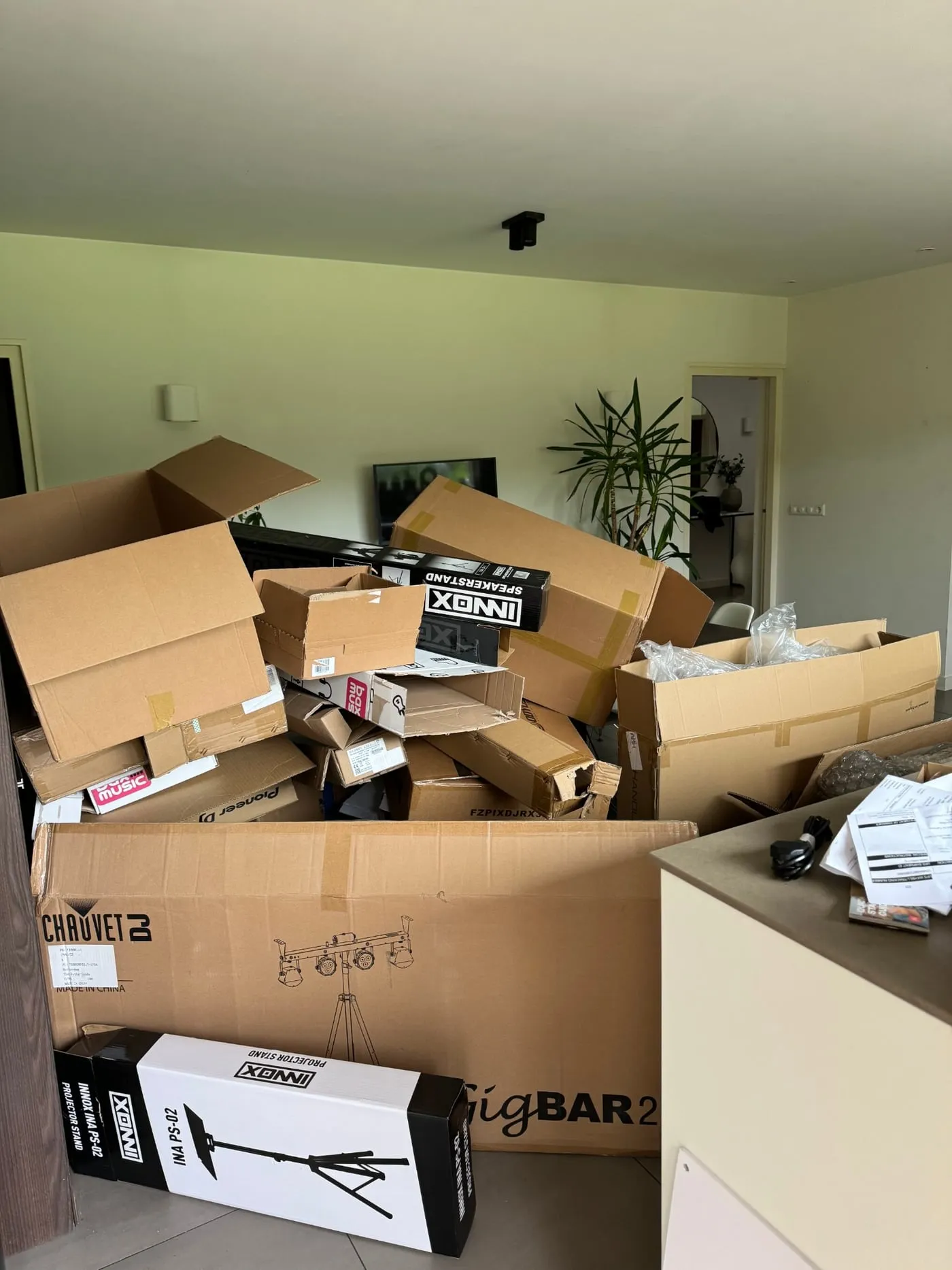
Flatten your boxes, pull off plastic and large strips of tape, and keep the cardboard dry. Tie it into bundles you can lift with one hand and put everything in one easy-to-reach spot. When you book, tell us which floor you are on, whether there is a lift and how far it is to the street, then send a photo via WhatsApp.
01Why does preparation make such a difference to the pickup?
Well-prepared cardboard is quicker to load and easier to estimate. That means a shorter collection and a fixed price that matches what is actually there.
When you book cardboard collection in Amsterdam, the way you prepare largely decides how smoothly it goes. Loose, assembled boxes take up three to four times as much space as flattened ones. That means extra trips down to the van, especially if you live on a high floor.
A tidy pile also helps us estimate the job up front. At Kartonophalers you get a fixed price based on the amount and your situation, such as the floor, the lift and the distance to the van. The clearer the picture you give us, the better that price fits.
You do not have to get everything perfect. We do the carrying ourselves, stairs included. But a few simple steps make the difference between a messy afternoon and a pickup that is done in no time.
02Should you flatten your cardboard boxes?
Yes, flattening is the single most important step. Flat boxes take up less room, stack more steadily and are faster to carry.
Cut or pull the tape off the bottom of each box and press it flat. For sturdy boxes that are glued shut, run a box cutter along one fold line. Work on a clear patch of floor so you have room to move and do not trip over half-folded cardboard.
After a move you are often dealing with dozens of boxes at once. Our page on moving boxes collection explains what to do with boxes that are still in good condition. If they are intact and clean, you might even pass them on to someone else who is about to move.
No time to flatten everything? Just mention it when you book. We will factor it into the estimate, so there are no surprises on collection day.
What about large boxes from furniture or appliances?
Big boxes from a sofa, wardrobe or fridge are best cut into two or three pieces. That way they fit through the narrow stairwells you find in so many Amsterdam buildings. Keep polystyrene and plastic wrap to one side, because they do not belong with the cardboard. For more on bulky furniture packaging, see our page on furniture packaging removal.
03Do you need to remove tape, staples and plastic?
It is best to remove bulky extras like plastic, polystyrene and long strips of tape. Small bits of tape and the odd staple are usually no problem for recycling.
During recycling, cardboard is turned into pulp and small foreign particles are filtered out. Large amounts of plastic make that process harder. Our article on what happens to collected cardboard explains why clean cardboard is easier to process.
Is there a lot of bubble wrap, foam or plastic filler mixed in? Put it in a separate bag. Our page on packaging waste collection explains how we handle mixed packaging.
You do not need to peel off address stickers and shipping labels. If you want to protect your privacy, just tear off the part with your name on it or make it unreadable.
04How do you keep cardboard dry until collection day?
Store cardboard indoors or under cover and only bring it out once the pickup starts. Wet cardboard is heavy, tears easily and is harder to recycle.
Amsterdam gets plenty of rainy days, and cardboard soaks up water like a sponge. A pile left out on the balcony or in the garden overnight will be noticeably heavier the next morning. Wet cardboard also sags and falls apart when you try to lift it.
Short on space inside? A storage room, a shared stairwell (with your owners' association's permission) or a covered bike shed works too. Do not lay the cardboard straight on a damp floor. Put it on a pallet or a few wooden slats instead.
Never put cardboard out on the pavement the night before. That can break the City of Amsterdam's rules on leaving waste in the street, and it will blow away or get soaked. We simply collect it from inside.
05What is the best way to bundle and stack cardboard?
Make stacks you can lift with one hand and tie them together with string or tape. Put small pieces into a larger box so nothing is left lying around loose.
A bundle about knee height is a good size. Anything bigger gets awkward on narrow stairs, and anything smaller just means more bundles to carry. Use parcel string or a few loops of tape to hold each stack together.
Gather loose scraps, egg boxes and small mailer boxes into one sturdy large box. Old paper such as newspapers and leaflets can go in a separate box or paper bag. Our page on paper recycling pickup lists what else we take.
After building work, cardboard can end up mixed with dust or leftover materials. Our page on renovation cardboard removal explains how to keep it separate from other construction waste.
06Where should you put the cardboard for the pickup?
Pick one spot in your home or building that is easy to reach, ideally close to the front door or the lift. Keep the route outside clear of bikes, buggies and other bits and pieces.
You do not need to bring the cardboard downstairs yourself. We collect it from wherever it is, including the third or fourth floor. One central spot in the hallway does save us hunting through different rooms.
In the city centre, stairs are often steep and narrow and loading spots are scarce. Our page on cardboard collection in Amsterdam city centre covers what to keep in mind there, such as the time windows for heavier vehicles.
The same idea works for businesses. Choose one fixed collection point in the stockroom or behind the shop. See business cardboard collection for tips on regular pickups.
07What should you include in your request, and why send a photo?
Tell us the amount, your floor, whether there is a lift, the distance to the street and your preferred day. A photo via WhatsApp gives us the fastest and most accurate estimate.
Filling in the form takes about 1 minute. You tell us what needs to go, roughly how much, your address and your preferred day. We then come by within 1 to 2 working days. You can book your pickup in 1 minute right now.
A photo says more than a description like "lots of boxes". Take one overview shot of the pile and, if you can, one of the stairwell or entrance. Send it via WhatsApp to 085 115 0200 (+31 85 115 0200) and you will get a fixed price up front that fits your situation.
Use the checklist below so you do not forget anything. That way you can be sure the pickup runs quickly and nothing gets left behind.
| Step | What to do | Why it helps |
|---|---|---|
| Flatten | Remove the tape, press boxes flat, cut large boxes into pieces | Less volume, fewer trips to the van |
| Remove plastic | Set aside plastic wrap, polystyrene and filler | Cleaner cardboard, better recycling |
| Keep it dry | Indoors or under cover, not on a wet floor | Wet cardboard is heavy and tears |
| Bundle | Knee-high stacks tied with string or tape | Easy to lift on narrow stairs |
| Gather small pieces | Put loose scraps into one large box | Nothing blows away or gets left behind |
| One fixed spot | Everything by the front door or lift, route kept clear | No searching, faster loading |
| Share your situation | Floor, lift, distance to the street, preferred day | A fixed price that matches reality |
| Send a photo | Overview photo via WhatsApp to 085 115 0200 | A fast, accurate estimate |
08What mistakes do people often make when preparing cardboard?
The most common mistakes are leaving cardboard outside, leaving everything loose and forgetting to mention the floor. Dirty cardboard mixed in with clean cardboard also causes problems.
Here is a typical example. A family in De Pijp puts all their boxes on the balcony after moving in. After one downpour half of them are soaked and the pile has stuck together. Keeping everything in the hallway would have avoided that.
Greasy pizza boxes, cardboard with food scraps on it and painted cardboard do not belong with ordinary cardboard. Keep them separate or let us know in advance. Not sure where something should go? Check our guide on where to dispose of cardboard in Amsterdam.
Finally, people sometimes forget to mention that there is no lift. That is no problem for us, but it does belong in the estimate. You can read more about how we work on our about us page or in the rest of the knowledge base.
Frequently asked questions
Do I need to bring the cardboard downstairs myself?
No, you do not. We do the carrying ourselves, including down stairs and from higher floors. Just let us know which floor you are on and whether there is a lift, so the fixed price you get up front is accurate.
What if I do not have time to flatten all the boxes?
Just mention it when you book. Assembled boxes take up more space and we include that in the estimate. That way you know exactly where you stand before we arrive.
Can I put the cardboard outside the night before?
We would rather you did not. Cardboard gets wet, it can blow away, and leaving waste outside can break the City of Amsterdam's rules. We collect it from inside your home or from your storage room.
Can old paper go in with the cardboard?
Yes, we also take old paper such as newspapers, magazines and leaflets. Put it in a separate box or paper bag so it stays together and nothing blows away.
Why do you ask for a photo?
A photo shows us straight away how much cardboard there is and how it has been prepared. That lets us give you a fixed price quickly that fits your situation. Send it via WhatsApp to 085 115 0200.
How soon do you come after I book?
Booking takes about 1 minute using the online form. We then come by within 1 to 2 working days, at a time we agree together.