What happens to cardboard after it has been collected?
Your boxes are out of the door, but that is not the end of their story. Cardboard is one of the most recyclable materials in your home. This article gives a broad outline of what happens after the pickup, and how you can make recycling easier. Whether you are clearing out after a move or running a busy stockroom, a few small habits help your cardboard get a second life.
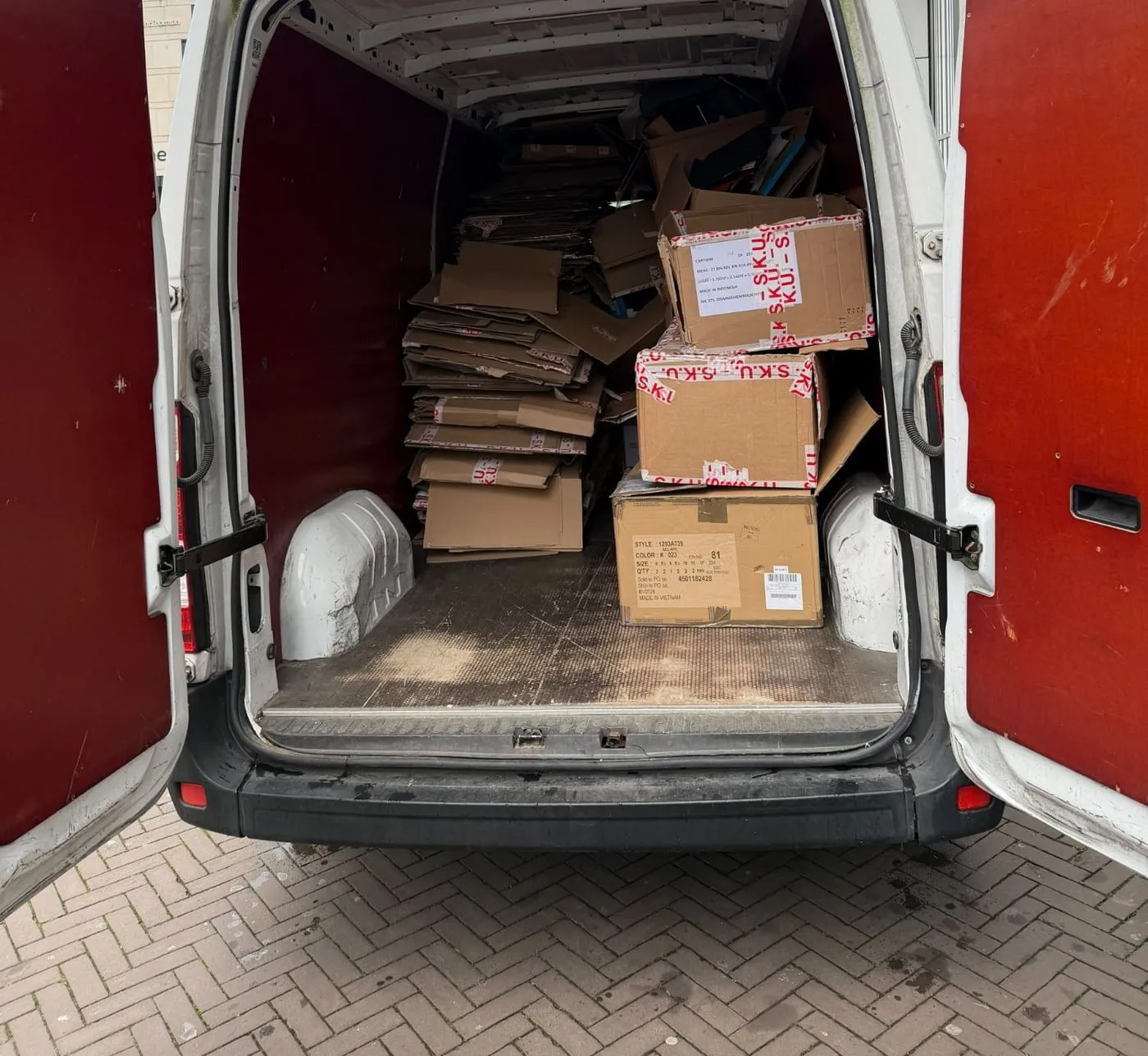
Collected cardboard goes to an approved recycling point for paper and cardboard recycling. There it is sorted, mixed with water into pulp and cleaned of tape, staples and other dirt. A paper mill then turns the clean fibre pulp into new cardboard or paper. Dry, clean cardboard gives the best fibres, while dirty or wet cardboard gives fewer.
01Where does the cardboard go after the pickup?
Cardboard collected by Kartonophalers goes to an approved facility for paper and cardboard recycling. So it is not burned or sent to landfill like general waste.
After a pickup we load the cardboard separately from other items. That keeps the stream clean, so it can be offered on as a raw material. The same goes for moving boxes, mailer boxes and old paper.
We do not name the processors we work with, but the principle is the same everywhere. Cardboard is gathered, pressed into bales and taken to a recycling company or paper mill. That is where the real reuse begins.
Curious how a pickup works at your home or office? Read more about cardboard collection in Amsterdam or our business cardboard collection.
02How is cardboard sorted?
Sorting separates cardboard from other paper and from materials that do not belong in it. The cleaner the cardboard arrives, the less is lost at this stage.
Paper and cardboard come in many types: corrugated board, solid board, newsprint and printed matter. Recyclers often sort by type, because each has different fibres and suits different products.
This is also the stage where large pieces of plastic, polystyrene, wood and metal are taken out. Some of that is done by machine and some by hand. Cardboard with lots of plastic wrap or filler makes sorting slower and more expensive.
That is why it pays to take packaging apart beforehand. Our page on packaging waste collection explains the easiest way to keep cardboard and plastic apart.
03What does pulping mean, and how is new cardboard made?
Pulping means cardboard goes into a large tank with water so the fibres come loose. That fibre pulp is then used to make new paper or cardboard.
A pulper works like a giant blender. The cardboard breaks down into loose cellulose fibres floating in the water. Tape, staples and other foreign particles are removed through screens and cleaning steps.
The clean pulp is spread out on a mesh, where the water drains away and is pressed out. The material then dries on heated rollers. The result is a new sheet of paper or board, which is turned into boxes, tubes or packaging.
The beauty of it is that the recycled share of the fibre needs no new trees. That makes cardboard one of the best-known examples of a material that stays in the loop.
| Stage | What happens | What you can influence |
|---|---|---|
| Pickup | Cardboard is loaded separately from other waste | Keep cardboard dry and set aside on its own |
| Baling and transport | Cardboard travels to the processor in bales | Flattened boxes take up less space |
| Sorting | Types of paper and board are separated, plastic and dirt removed | Remove plastic wrap, polystyrene and filler beforehand |
| Pulping | Cardboard is mixed with water into fibre pulp | Keep grease and food scraps out |
| Cleaning | Tape, staples and small particles are screened out | Pull off long strips of tape |
| Making new board | Pulp is spread, pressed and dried into new sheets | Dry cardboard gives stronger fibres |
04Why is dry, clean cardboard easier to recycle?
Dry, clean cardboard has stronger fibres and contains less dirt that needs removing. Wet cardboard is heavy, goes mouldy faster and gives lower-quality fibres.
Water itself is not a problem in the pulper. The trouble starts when cardboard stays wet for a long time. The fibres weaken, mould can develop and the cardboard picks up dirt from the street.
Wet cardboard is also much heavier to lift and transport. You notice that when you lug it to a bin, and we notice it when carrying it down the stairs. That is why we always advise storing cardboard indoors or under cover.
How to do that at home is set out step by step in how to prepare cardboard for pickup. You will also find a checklist there so you do not miss anything.
05Can a greasy pizza box go in with the cardboard?
A pizza box with lots of grease or leftover food is less suitable for recycling. Grease is hard to separate from the fibres during pulping.
Grease soaks deep into cardboard and clings to the fibres. In the pulp it creates spots and weak patches in the new material. That is why many councils ask people to put heavily soiled cardboard in general waste. For the current rules, check what the City of Amsterdam advises.
A practical tip is to tear off the clean part of the lid and put only that in with the cardboard. The greasy base goes separately. That way most of the box is still usable.
For restaurants and cafés this comes up every day. Our page on cardboard collection for shops and restaurants explains how to keep clean and soiled cardboard apart in a busy kitchen.
- Goes in with the cardboard: clean boxes, mailer boxes, egg boxes, tubes, newspapers and leaflets
- Better kept separate: cardboard with grease, food scraps, paint or oil
- Does not go in with the cardboard: polystyrene, plastic wrap, drinks cartons, vinyl-coated wallpaper
06How many times can cardboard fibres be reused?
Cardboard fibres can be reused several times before they become too short and weak. Each round of recycling shortens the fibres a little, which is why some fresh fibre is often added.
Every time cardboard is pulped and dried again, the fibres get slightly damaged. After a number of rounds they are too short to form a strong sheet. Those very shortest fibres are filtered out during the process.
That is why it is worth collecting cardboard separately again and again. Every box that goes the right way supplies fibre for the next round. A box thrown in general waste, on the other hand, drops out of the loop for good.
Reusing a box comes even before recycling. Moving boxes in good shape can sometimes be passed on to someone else who is about to move. Read more on our page about moving boxes collection.
07How can you help your cardboard get recycled properly?
You help most by offering cardboard dry, flat and as clean as possible. Getting rid of it separately through an approved route makes sure it really does get recycled.
Here is a typical example. An office in Amsterdam-Zuid collects mailer boxes in one corner of the stockroom each week. By keeping them dry and the plastic wrap separate, the stream stays clean and the pickup goes quickly. That saves both space and time.
For households, the big question is often where all that cardboard should go. The paper bin fills up fast and bulky waste is not the right route. Our articles on cardboard and bulky waste in Amsterdam and where to dispose of cardboard in Amsterdam set out the options.
Rather not sort it out yourself? Kartonophalers collects cardboard and old paper and takes it to approved recycling. You get a fixed price up front and can book your pickup in 1 minute. You will find more background in our knowledge base.
Frequently asked questions
Do you burn the cardboard you collect?
No. The cardboard we collect goes to an approved facility for paper and cardboard recycling. There it is processed into raw material for new paper and cardboard.
Do I need to remove tape and staples?
Small bits of tape and staples are screened out during pulping. It is still best to remove long strips of tape, plastic wrap and polystyrene. That makes sorting easier.
Can wet cardboard still be recycled?
Slightly damp cardboard is usually still usable, but cardboard that has been wet for a long time loses quality. It is heavier, can go mouldy and gives weaker fibres. So store your cardboard indoors or under cover.
Do drinks cartons count as cardboard?
No, drinks cartons contain layers of plastic and often aluminium as well as cardboard. In Amsterdam they are generally collected differently from paper and cardboard. Check the City of Amsterdam for the current rules.
Do you also take old paper for recycling?
Yes, as well as cardboard we collect old paper such as newspapers, magazines, leaflets and archive paper. It goes along with the cardboard to paper and cardboard recycling.
Which is better: reusing or recycling?
Reusing comes first. A sturdy box that can be used again does not need processing at all. If the box is damaged or you have no further use for it, recycling it separately is the best route.