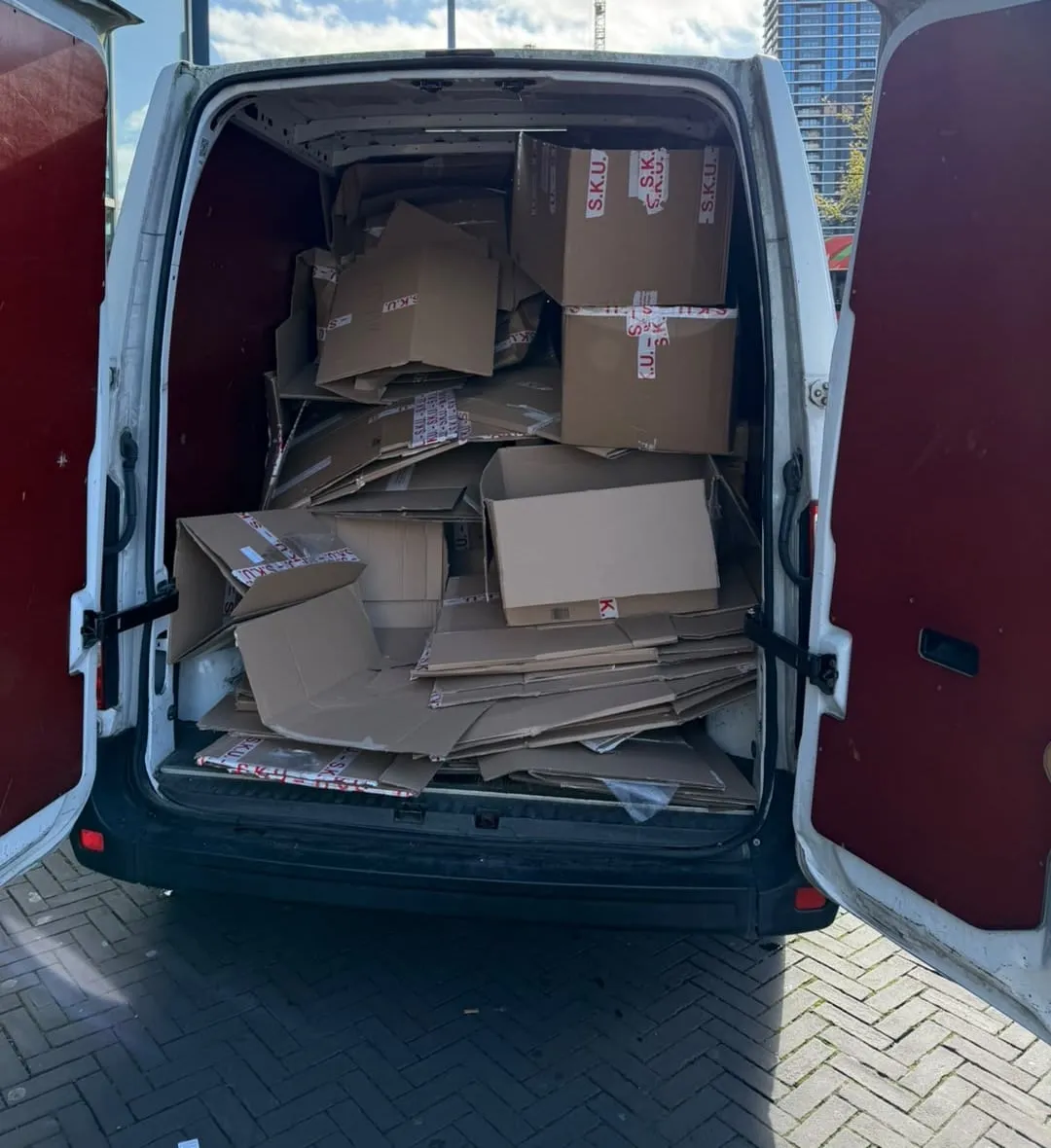
Request a pickup online in 1 minute, or send a photo on WhatsApp. You get a fixed price up front, based on the amount and the situation on site. Within 1 to 2 working days we collect the boxes, including from a small back room or an upper floor. Book a one-off pickup after a delivery or a recurring one, weekly or fortnightly by arrangement.
01Why does a clothing store have so much cardboard?
Clothing arrives per collection in large boxes, with every garment in its own plastic bag. On top of that come mid-season drops, reorders and boxes of hangers and shop supplies, so the flow of cardboard never really stops.
Fashion retail no longer runs on just two seasons a year. Alongside the spring and autumn collections there are mid-season drops, capsules and restocks of styles that sell well. Every delivery means a new pile of boxes, often from several suppliers at once.
Clothing boxes are light but bulky. A box of jumpers or coats takes up a lot of space, even when it is empty. Flattened, it is manageable, but if nobody has time to flatten everything after a delivery, the back room fills up within a day.
Then there are the boxes from hangers, clothing rails, price guns, carrier bags and other shop supplies. Clothing rails often come in long, rigid boxes that do not fit anywhere. We take those too.
02What do you do with the polybags and plastic from the boxes?
Clothing almost always comes in a plastic bag, a polybag, inside the box. That plastic does not belong with the cardboard: take it out, and mention it in your request if you have a large amount as well.
Unpacking a collection creates a mountain of plastic next to the cardboard: polybags, wrap around stacks, and sometimes plastic hangers and tags. If that stays mixed in with the cardboard, the cardboard is harder to recycle. So collect the plastic separately in a bag or bin.
If you have lots of bags of plastic after a big delivery, let us know separately in your request or on WhatsApp. We will agree in advance what we can take and how. That way nobody gets a surprise on the day.
Small things like a strip of tape, a paper packing slip or a cardboard swing tag can stay with the cardboard. We are talking about large amounts of plastic, not every loose scrap. Read more about mixed packaging waste on our page about packaging waste collection.
| Material | With the cardboard? | What to do |
|---|---|---|
| Clothing boxes and suppliers' outer cartons | Yes | Flatten and keep them together |
| Long boxes from clothing rails and displays | Yes | Flatten, remove loose parts and screws |
| Boxes from hangers, bags and shop supplies | Yes | Flatten or nest inside each other |
| Paper packing slips, tissue paper, cardboard tags | Yes | Can stay with the cardboard |
| Polybags and plastic wrap around garments | No | Collect separately and mention them in your request |
| Plastic hangers and clips | No | Keep them apart or reuse them |
| Wet boxes from a leaking basement | Let us know | Keep them apart and mention them in advance |
03When does a fashion store have the most cardboard?
Most cardboard is released around the change of season and in the weeks before the holidays. Plan an extra pickup on top of your usual schedule during those periods, so your back room does not grind to a halt.
The spring collection arrives around February and March, the autumn collection around August and September. In those weeks you process a lot of deliveries in a short time. At the same time you want to rehang the shop, change the window display and move the old collection to the back.
It builds up again in November and December. There are extra deliveries for the holidays, gift packaging and often new bags or boxes to sell. That is exactly when your shop is busiest and you have the least time to deal with boxes.
A typical scenario: a fashion store in Zuid receives the entire autumn collection from four suppliers within two weeks in September. The boxes are stacked in the corridor to the fitting rooms, and the team unpacks between customers. One extra pickup right after the last delivery clears the corridor in one go.
- Change of season in spring and autumn
- Mid-season drops and capsules
- Reorders of best-selling styles
- Refitting the shop or new rails
- The holidays and the weeks before
04How do you keep the fitting rooms and back room free of boxes?
Use one fixed spot for cardboard and have it cleared regularly. Once boxes start spreading through the shop, they cost you space, time and the look of your store.
In a clothing store, cardboard often ends up where it does not belong. A few boxes next to the fitting rooms, a stack behind the counter, a corridor to the toilet that is full. Customers notice, and it does not match the image you want your shop to have.
Choose one spot for flattened cardboard, as close to the back exit as possible. Agree with your team that every box is flattened straight after unpacking and goes to that spot. That way you also know exactly how much there is when you book a pickup.
A clear back room is also a safety matter. The route to the emergency exit must always be clear, even on a busy delivery day. Regular collection stops cardboard from quietly blocking it.
What if there is no back entrance?
Many shops in Amsterdam only have a front door. In that case we collect before opening or after closing, when there are no customers. With flattened boxes stacked neatly together, it is quick and the shop floor stays clean. Read our tips on how to prepare cardboard for pickup.
05What is the difference between a small boutique and a large clothing store?
A small boutique has little cardboard but almost no storage, while a large store has storage but far more volume. Both benefit from collection; only the rhythm differs.
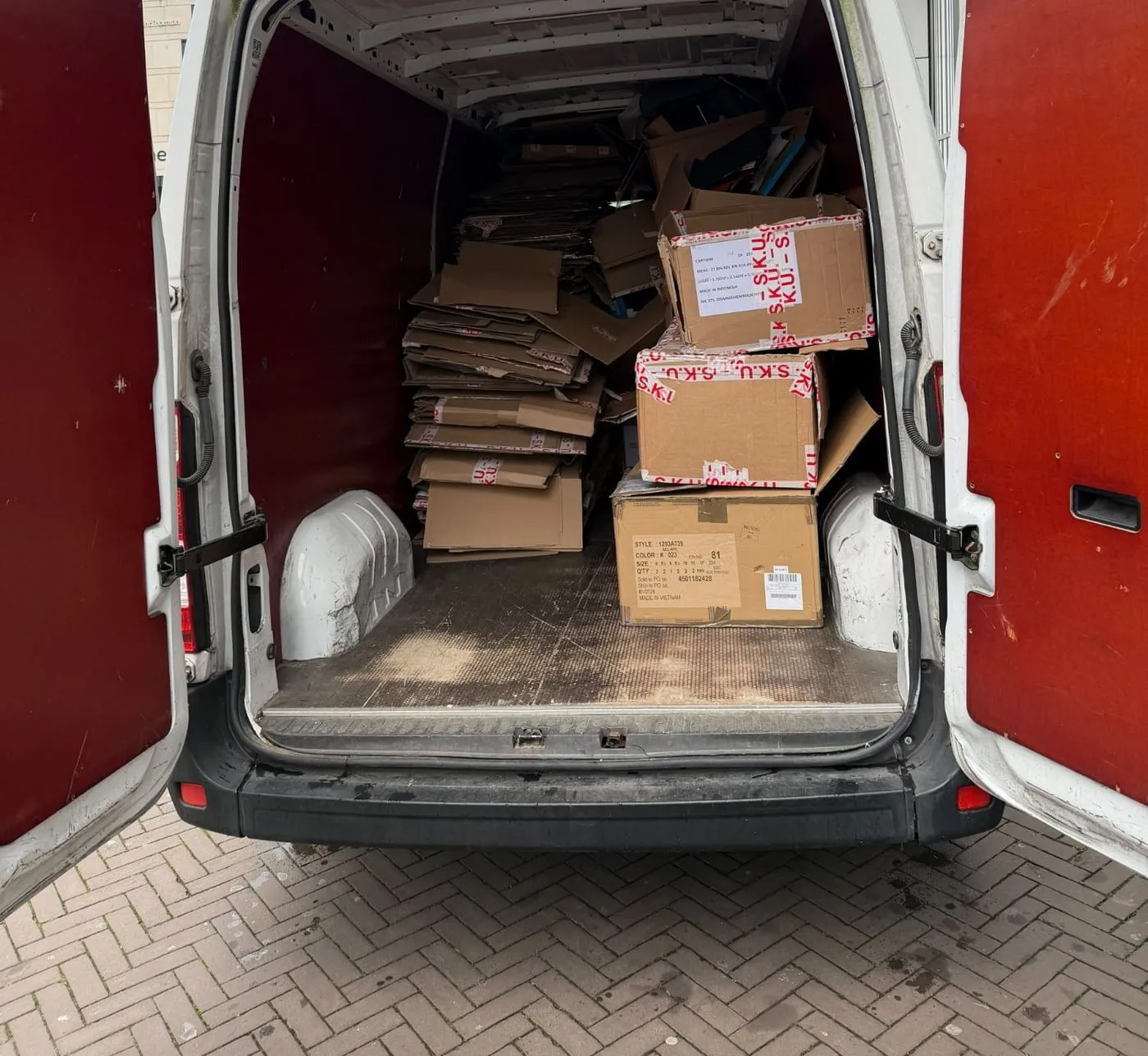
In the narrow shopping lanes between the canals you find boutiques with a shop floor only a few metres wide. There is hardly any storage, sometimes just a cupboard or a corner under the stairs. A couple of deliveries are enough to fill that space completely.
A larger clothing store in a shopping centre or on a wide shopping street does have a stockroom. There the problem is volume: many suppliers, many boxes a week and staff who would rather be on the shop floor than hauling cardboard.
A pickup by appointment works for both. A boutique often chooses collection after every large delivery or every two weeks. A large store is more likely to go for a fixed weekly pickup.
| Type of shop | Typical bottleneck | Approach that often works |
|---|---|---|
| Small boutique in the city centre | Almost no storage, front door only | Pickup after every large delivery, before opening |
| Fashion store on a neighbourhood shopping street | Back room fills up around the change of season | Fortnightly, with an extra pickup at peak times |
| Large clothing store with a stockroom | Many suppliers and high weekly volume | Weekly in a fixed time slot |
| Shop in a covered shopping centre | Service corridor and set delivery hours | Fixed moment within the centre's hours |
06How do we collect cardboard from a boutique in the city centre?
In the city centre we prefer to come early, before opening, and to stop as close to the door as we can. We plan around narrow streets, limited loading space and time windows for heavier vehicles.
Boutiques on the old shopping lanes are often in canal houses. The stockroom is an attic room or a basement, reached by a steep staircase. We do the carrying ourselves, including on those stairs, so you do not need to bring the cardboard down first.
There is usually little room in front of the door. So we load quickly and efficiently, which works best when the boxes are flattened and bundled. Read more about working in the historic centre on our page on cardboard collection in Amsterdam city centre.
A typical scenario: a boutique on a side street in the canal belt receives three boxes of new stock on Tuesday and two more on Thursday. By then the little room behind the shop is already full. A Friday morning pickup before opening frees up the space for the weekend.
07Can a clothing store put cardboard in the paper bins on the street?
No, as a business you are not allowed to put your cardboard in the municipality's household paper bins. Commercial waste has to be collected, and that applies to a small boutique too.
The underground paper bins on your street are meant for residents. Businesses fall under different rules. Check the City of Amsterdam (gemeente Amsterdam) for the current rules, or read our overview of the cardboard disposal rules in Amsterdam.
In practice, a bin on a shopping street also fills up fast. Boxes left next to it get wet, blow away and annoy neighbours and other shopkeepers. Wet cardboard is heavy and harder to recycle.
Not sure what your options are? Have a look at where to dispose of cardboard in Amsterdam. For a shop with regular deliveries, a pickup by appointment is usually the most practical route.
08Can you combine cardboard collection with a weekly pickup?
Yes, most clothing stores choose a regular pickup and book an extra round at peak times. Weekly, fortnightly or monthly is agreed with you, and the schedule is easy to adjust.
A regular pickup clears the daily flow of boxes without you having to think about it every time. We match the time slot to your opening hours and delivery days. That way the cardboard is never in the way for long.
At the change of season or around the holidays, you can easily add an extra pickup. In quiet weeks you can push a round back instead. There is no long-term contract; you adjust it as your shop changes.
Read more about regular pickups on our page about weekly cardboard collection. If you also run a webshop alongside your store, cardboard collection for webshops is worth a look too, because returns and shipping boxes are added to the mix.
09How do you set out clothing boxes on collection day?
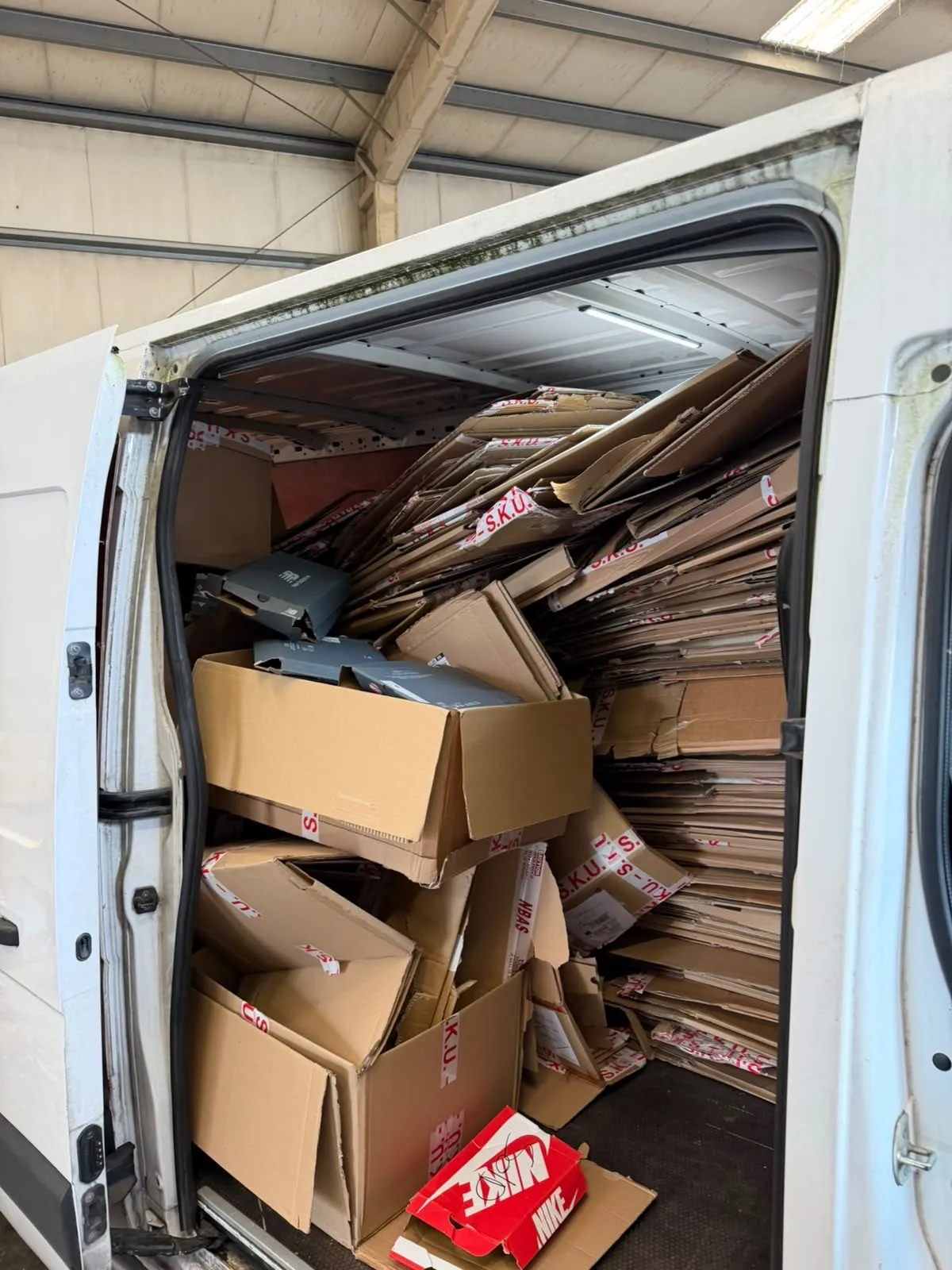
Flatten the boxes, take the plastic out and put everything in one spot near the exit. Then we are done quickly and your shop barely notices.
Start the evening before, after closing. Walk through the back room, the fitting room corridor and the space under the till and gather every box still lying around. You will often find a few half-full boxes of hangers or bags that need unpacking first.
Flatten each box by cutting the tape on the bottom. Stand the flat boxes upright against a wall or tie them into manageable bundles with string. Put the long boxes from rails at the bottom or keep them separate so they do not bend.
Keep the cardboard dry. Do not leave it out on the pavement while you wait for the pickup, because one rain shower makes it heavy and harder to recycle. Cardboard on the street is also a nuisance on a shopping street and can blow away.
Let one colleague know what time we are coming and where the cardboard is. For a pickup before opening, that is usually the person who opens the shop. That way we do not have to search and the van spends as little time as possible outside your door.
- All boxes gathered from the back room, fitting rooms and till area
- Boxes flattened and standing upright or bundled
- Polybags and plastic wrap separately in a bag
- Cardboard kept dry indoors, not on the pavement
- Route to the door clear of rails and stock
10How do you book a pickup and what does it cost?
You book a pickup in 1 minute and get a fixed price up front. Kartonophalers is a paid service: we do not collect for free and we do not buy cardboard.
In the form, fill in what needs to go, roughly how much, the address and your preferred day. Mention that it is a clothing store, where the cardboard is and whether there is a lot of plastic as well. A photo on WhatsApp to 085 115 0200 (+31 85 115 0200 from abroad) makes it even faster.
The price depends on the amount and the situation, such as the floor, a lift and the distance to the van. We come by within 1 to 2 working days. The cardboard goes to certified paper and cardboard recycling.
Kartonophalers is part of Meubelophalers: you deal with the team behind Meubelophalers, with 1,650+ happy customers. Find out more on our about us page. Ready to plan? Book your pickup in 1 minute.
11Where in Amsterdam do we collect cardboard from clothing stores?
We collect in every Amsterdam district and in the towns right around it. From boutiques in the canal belt to large fashion stores in shopping centres.
We cover Centrum, Zuid, West, Oost, Noord, Nieuw-West and Zuidoost, plus Amstelveen, Diemen, Badhoevedorp, Zaandam, Hoofddorp, Ouderkerk aan de Amstel and Duivendrecht.
If your shop has a slightly different focus, for example shoes as well as clothing, also take a look at cardboard collection for shoe stores. For shops and hospitality in general, see cardboard collection for shops and restaurants.